
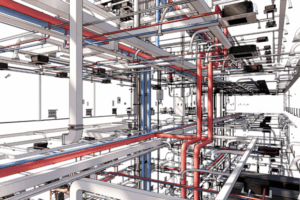
As the volume and sensitivity of information continue to grow, the facilities designed to protect that information are under increasing pressure to perform. Behind the scenes, the systems that power, cool and support these spaces play a critical role in safeguarding operations and maintaining reliability under demanding conditions.
In this Q&A, Wismith Geffrand, project manager and electrical designer at Bowman, explains how mechanical, electrical and plumbing (MEP) systems shape the performance and resilience of sensitive compartmented information facilities, or SCIFs. He shares where risks often emerge, why early coordination is essential and how intentional system design helps support mission-critical operations from day one.
Q: What is a SCIF, and how do its security requirements fundamentally change the way MEP systems are planned and designed?
A: At its core, a SCIF, short for sensitive compartmented information facility, is designed to protect highly classified information from physical and electronic threats. That protection goes far beyond card readers and reinforced walls. From an MEP perspective, every system that enters or exits the space becomes part of the overall security strategy.
Unlike conventional facilities, MEP systems in SCIFs must do more than meet efficiency goals or code requirements. HVAC, power, lighting, fire protection and controls are carefully designed to prevent unintended signal transmission, unauthorized access or exploitable vulnerabilities. This requires a different approach from the outset, including fewer penetrations, tighter control of system pathways and a higher level of coordination across disciplines. In a SCIF, MEP systems do not simply support the space, they help protect it.
Q: What makes designing for SCIFs and other secure facilities unique compared to traditional MEP projects?
A: SCIF and secure facility design is defined by the high level of precision, control and accountability required. Unlike conventional MEP projects, these environments are governed by strict criteria such as ICD 705, which dictate system routing, penetrations, grounding, isolation and power distribution. There is minimal tolerance for interpretation or late-stage modifications, every design decision must be deliberate, coordinated and fully defensible.
From an MEP perspective, all disciplines contribute to protecting the secure envelope. Mechanical systems must provide reliable environmental control while limiting penetrations and eliminating unintended signal pathways. This is achieved through intentional routing strategies and secure detailing, including the use of waveguides and man-bars where required, to maintain shielding continuity without compromising maintainability. Electrical systems must go beyond basic reliability, incorporating tightly controlled power entry, dedicated and isolated infrastructure, clearly defined grounding strategies and power line filtering to mitigate conducted emissions and reduce the risk of signal leakage.
At Bowman, we take a holistic, integrated approach to SCIF design. Our teams understand how mechanical routing, electrical distribution, grounding, power filtering and secure penetration methods intersect and how each decision impacts the overall security posture. This level of coordination allows us to deliver MEP systems that support mission critical operations while maintaining strict compliance with secure facility requirements.
Q: What are the most common risks that can compromise SCIF integrity if not addressed early in design?
A: Most SCIF vulnerabilities do not come from a single system failure but from missed coordination early in design. HVAC penetrations are a common example. If ductwork, dampers or exhaust paths are not carefully detailed, they can compromise the secure perimeter. Power and grounding pathways present another key risk, as improper grounding or shared systems can create unintended signal paths.
Signal leakage is always a concern, especially where MEP systems intersect with IT and low-voltage infrastructure. Without early alignment, even well-intentioned design decisions can introduce vulnerabilities. That is why we approach SCIF projects as proactive risk managers, identifying potential points of failure early, collaborating closely with architects and security teams and resolving issues before they reach construction.
Q: Oftentimes, SCIFs are built within existing buildings. What unique engineering challenges arise in SCIF retrofits, and how does Bowman mitigate them?
A: Retrofits introduce some of the most complex challenges in SCIF engineering. Existing buildings were not designed with secure facilities in mind, which often means tight space constraints, limited ceiling heights and aging infrastructure. When projects must also account for occupied spaces and phased construction, that complexity increases quickly.
The challenge is upgrading or adapting systems without disrupting operations or compromising security. Bowman addresses this by starting with a detailed assessment of existing conditions and infrastructure capacity. We plan upgrades strategically, isolate secure systems where necessary and carefully sequence construction to reduce risk. The goal is to make the SCIF function as if it were purpose built, even when the building itself was not.
Q: How does early MEP involvement improve outcomes on SCIF projects?
A: Early MEP involvement is one of the most significant differentiators in successful SCIF projects. When teams are engaged early, they can influence building layout, system routing and infrastructure planning in ways that reduce risk and cost later. This approach allows conflicts to be identified and resolved before they are built, not after.
More importantly, early collaboration helps align security, operational and sustainability goals from the start. SCIF projects are too complex for a siloed approach. By integrating MEP engineering into the early design process, Bowman helps clients move faster, avoid costly redesigns and deliver secure facilities that perform as intended from day one.
Q: Looking ahead, as secure facilities evolve, what trends are shaping the future of designated SCIF areas, and how is Bowman preparing clients for what’s next?
A: SCIFs are increasingly demanding more power, more cooling and greater flexibility as operations become more data intensive and technology driven. At the same time, clients are focused on balancing these requirements with sustainability goals, decarbonization efforts and long-term resilience.
This will require designing for higher power densities, smarter system controls and efficient energy use without sacrificing reliability or security. Remote monitoring and advanced controls will become more common but must be implemented thoughtfully to maintain isolation. At Bowman, we’re helping clients plan scalable and adaptable systems so today’s secure facilities do not become tomorrow’s constraints.
About Wismith Geffrand
Wismith Geffrand is a project manager and electrical designer with more than eight years of experience delivering power, lighting, fire alarm and low-voltage system designs for commercial interior and secure government projects. At Bowman, he is responsible for the electrical design of assigned projects, supporting office, healthcare, laboratory and classified environments throughout the Mid-Atlantic region. His technical background includes low-voltage power distribution, lighting and emergency systems, as well as close coordination with multidisciplinary teams to deliver constructible, code-compliant solutions that support security and operational requirements.
Tags:MEPPerspectivesQ&A
Share