
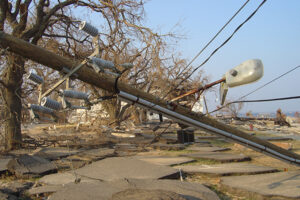
The December issue of Civil + Structural Engineer features Spencer Francis, PE, EVP & Reg. Manager & Jason Reynolds, Registered Professional Land Surveyor & Principal at Bowman. Francis wrote about infrastructure resiliency amid hurricanes & all wicked weather.
In the midst of an active hurricane season, Bowman (Nasdaq: BWMN), a growing multidisciplinary professional services firm, is improving community infrastructure nationwide and assessing areas of future risk. As we’ve seen, the National Oceanic and Atmospheric Administration (NOAA), predicted an above-average season for hurricanes this season in the Atlantic Basin.
Just as the U.S. Senate passed a trillion-dollar infrastructure package, Reston, Va.-based Bowman’s team of experts are at work for a range of clients, from utilities to land developers and others with services such as civil, mechanical, electrical and plumbing (MEP), and transportation engineering, surveying and mapping.
“We’re in the height of hurricane season and it’s on everyone’s mind in the wake of Hurricane Ida and as Tropical Storm Sam moves westward,” said Spencer Francis, Executive Vice President at Bowman. “All of these weather events demonstrate the need for continued diligence in infrastructure resilience.”
Offering a broad range of real estate, energy, infrastructure, and environmental management solutions to public and private clients across the country, Bowman’s expert engineers and planners know how to design community infrastructure to be more resilient to hurricanes and other major weather events. They also know how to quickly and safely survey the damage using the most high-tech methods available.
Much of Francis’ job and that of his team is working with energy companies and communities to harden or relocate power lines and microgrids underground. This helps communities become more resilient in extreme weather situations, such as this year’s increasingly severe storms, flooding, and last year’s active hurricane season. Francis and his team work with utility contractors and company engineers to move hundreds of miles of electrical lines and microgrids underground every year. This, in turn, positively affects tens of thousands of properties a year.
Often, Francis’ team works with Bowman surveyors on similar projects but instead of power lines outside of homes and neighborhoods, the surveyors may be using 3-D scanning technology to survey and properly secure electrical substations. The improved technologies improve accuracy and safety.
Jason Reynolds, a Bowman Principal and 30-year veteran surveyor based in Austin, Texas, works with his team to utilize thermography video and drones to assess post-hurricane damage or look for vulnerable infrastructure. He responded to Hurricane Harvey in 2017 to assist with the identification of damaged transmission and distribution lines.
The transmission lines and majority of the distribution lines post-Harvey were flown over a wide area with a manned helicopter outfitted with an on-board video camera with embedded GPS positions across a three-county area. Distribution lines that were in heavily vegetated areas were flown with Unmanned Aerial Systems equipped with GPS, video and thermal cameras. All crews were accompanied by a utility representative subject matter expert. When a downed or malfunctioning line was identified, the coordinates were called in to the damage response center via satellite phones to dispatch crews for repair or rebuild.
Afterwards, a “lessons learned” exercise was conducted with stakeholders and a readiness condition plan was formalized for future storms. This included triggers to prepare for an assessment program as the hurricane was developing, gather response assets, mobilize crews to a safe area near the anticipated impact point prior to the hurricane making landfall, followed by deployment to the damage assessment rally point as soon as conditions allowed for safe flight operations. This plan was utilized during the 2019 Chantel storm.
Flight crews and 20 land-based crews accompanied the assessment days ahead of the storm and were ready to assist utility providers, however the storm was downgraded and there was minimal damage.
To handle the sheer magnitude of data and complex moving parts of these programs, Bowman consistently works to improve processes and procedures to improve efficiency and accuracy. Among these improvements came the development of an online database which provides real-time project tracking and reporting utilizing the latest cloud-based and geographic information system (GIS) technology.
Tags:ArticleEngineeringSurveying
Share